What MSPs Stand For and Why They Matter for Healthcare CFOs

What MSPs Stand For and Why They Matter for Healthcare CFOs

Introduction

In the intricate realm of healthcare, the significance of Managed Service Providers (MSPs) has become paramount for ensuring operational efficiency and regulatory compliance. By outsourcing IT management to these specialized firms, healthcare organizations can bolster their cybersecurity measures and concentrate on their primary mission: delivering exceptional patient care.

As the landscape of healthcare technology evolves, a pressing question arises: how can healthcare CFOs harness the expertise of MSPs to adeptly navigate the challenges of compliance and security while maximizing operational effectiveness?

The answer lies in recognizing the critical role MSPs play in addressing the multifaceted cybersecurity threats that healthcare organizations face today.

Define Managed Service Providers (MSPs)

MSPs stands for Managed Service Providers, which are companies that remotely oversee a medical entity's IT infrastructure and end-user systems. Their services encompass network management, cybersecurity, data backup, and compliance support, enabling healthcare providers to concentrate on their primary mission—delivering exceptional patient care. In an era where technology is paramount, MSPs play a pivotal role in assisting organizations in adhering to stringent regulations such as HIPAA. By outsourcing these essential functions, medical entities gain access to advanced technology and specialized expertise, significantly reducing the administrative burden associated with in-house management.

The impact of MSPs on medical compliance is substantial. They implement robust security measures, conduct regular audits, and prepare entities for external evaluations, ensuring that compliance frameworks are not only met but exceeded. One MSP, for instance, offers comprehensive services that integrate proactive risk management, audit support, and compliance training. This ensures that medical organizations are audit-ready and can effectively safeguard patient health information (PHI).

Industry leaders underscore the advantages of delegating IT responsibilities. As Bernadette Wilson articulates, "An MSP provides the benefit of a skilled ally," highlighting the significance of specialized expertise in managing the complexities of IT within the medical field. Furthermore, MSPs enhance operational effectiveness by delivering adaptable solutions tailored to the specific needs of medical institutions, ensuring they can respond to evolving regulatory landscapes and technological advancements.

The managed services sector is projected to approach nearly $350 billion globally by the end of 2024, underscoring the increasing reliance on MSPs in healthcare. Case studies reveal that medical entities utilizing MSPs, such as those leveraging advanced services, experience improved IT infrastructure management. For example, one MSP conducts thorough assessments to identify compliance gaps and risks, offering actionable recommendations to bolster security configurations and enhance staff cybersecurity training. Overall, MSPs are indispensable partners in the medical field, empowering entities to thrive securely in a digital-first environment.
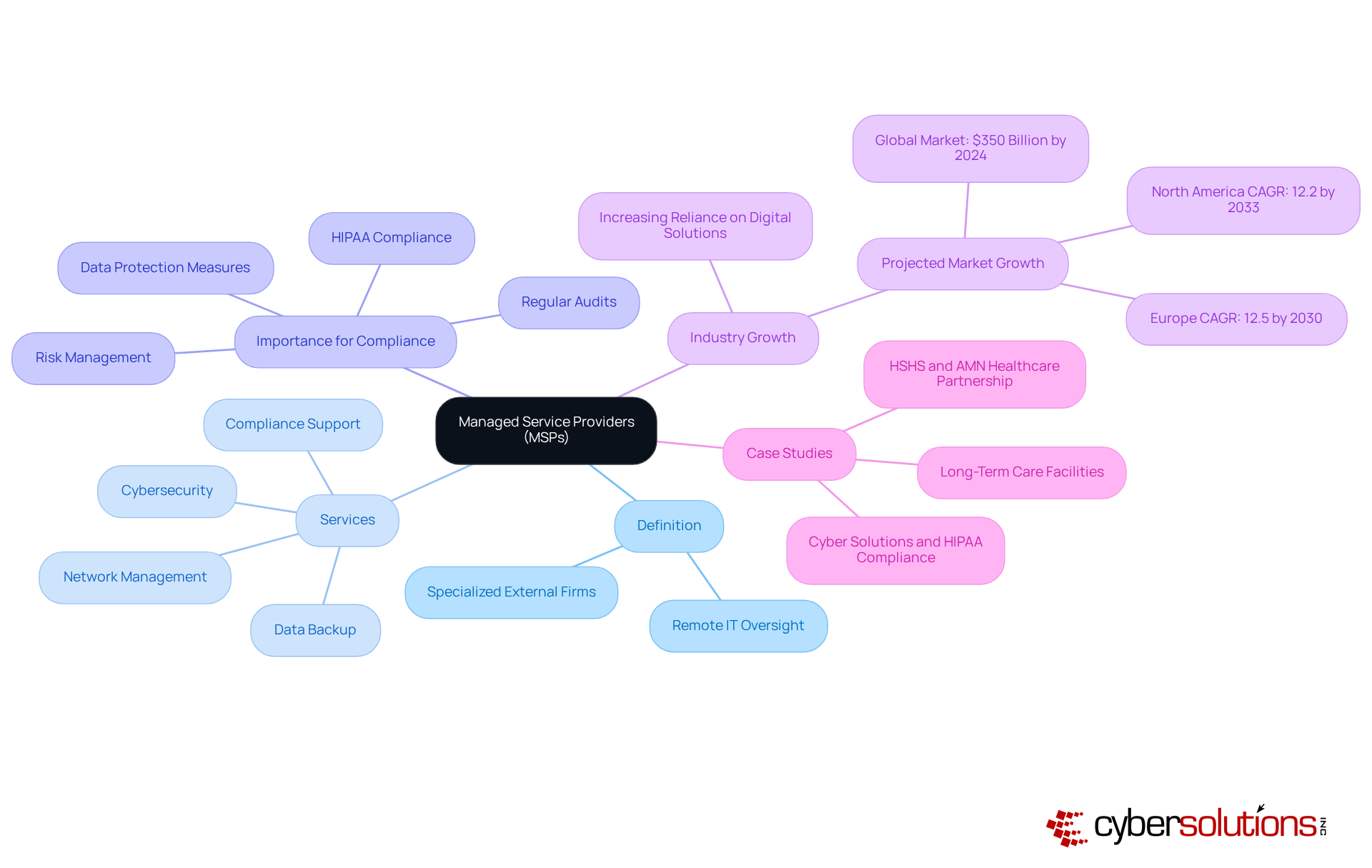
The central node represents MSPs, while the branches illustrate their various roles and impacts. Each color-coded branch helps you quickly identify different aspects of MSPs, making it simple to see how they contribute to healthcare.

Explain the Importance of MSPs in Modern Business

In today's swiftly changing business environment, the role of managed service providers, which MSPs stands for, has become crucial in enhancing IT operations for medical entities. With the increasing prevalence of cyber threats, healthcare CFOs must prioritize cybersecurity measures to protect sensitive patient data. MSPs offer access to advanced technologies and specialized expertise, enabling these financial leaders to maintain a competitive edge without the burden of extensive in-house IT resources.

One of the key advantages of partnering with an MSP is the predictable pricing model, which simplifies budgeting and enhances financial predictability. This model removes unforeseen IT costs, allowing organizations to allocate resources more efficiently. For instance, those utilizing managed security services can achieve significant cost savings. Furthermore, by partnering with MSPs, organizations significantly reduce downtime—an essential factor in medical environments where service interruptions can hinder patient care and lead to substantial revenue losses.

In 2023, the average expense of a healthcare data breach rose to $10.93 million, underscoring the necessity for strong cybersecurity measures that MSPs provide. Notably, 81% of firms are opting for external expertise to bolster their cybersecurity defenses, reflecting a growing trend within the industry. Additionally, MSPs stand for compliance specialists, who assist organizations in navigating the complexities of regulatory compliance, ensuring adherence to industry standards such as HIPAA. Their comprehensive services integrate robust cybersecurity measures, proactive risk management, and expert guidance, helping organizations avoid costly penalties.

With nearly 158 million medical records compromised in recent years, the urgency for effective cybersecurity cannot be overstated. Moreover, MSPs offer continuous monitoring services, ensuring that suspicious activities are detected and addressed before they escalate into significant threats. By streamlining operations and enhancing efficiency, MSPs empower financial officers in the medical sector to focus on strategic initiatives that foster organizational success, all while providing flexible and scalable delivery models to adapt to evolving requirements.

The central node represents the main theme, while the branches show the various benefits and statistics related to MSPs. Each color-coded branch helps you quickly identify different aspects, making it easier to understand the overall importance of MSPs in the healthcare sector.

Outline Common Services Provided by MSPs

In today's healthcare landscape, the role of Managed Service Providers, which MSPs stands for, is more crucial than ever. They offer a variety of services tailored to meet the specific needs of medical institutions, ensuring that these organizations can navigate the complexities of modern technology while maintaining high standards of patient care. Key offerings include:

  1. IT support: Continuous oversight of IT systems enables the early detection and resolution of issues, minimizing downtime and ensuring operational efficiency. Statistics indicate that healthcare organizations utilizing 24/7 IT support experience significantly reduced incident response times, enhancing overall service reliability.
  2. Cybersecurity: MSPs enforce strong security protocols aimed at safeguarding sensitive client information from emerging cyber threats. Investing in comprehensive cybersecurity is essential for protecting sensitive information and preserving trust. MSPs integrate advanced encryption, multi-factor authentication, endpoint protection, and access control measures to prevent unauthorized access, ensuring compliance with regulations.
  3. Data backup: These services ensure that critical data is regularly backed up and can be swiftly restored in the event of a breach or system failure, thereby minimizing potential disruptions to patient care.
  4. Compliance assistance: MSPs assist in navigating intricate regulatory frameworks such as HIPAA, PCI-DSS, and GDPR, ensuring adherence to essential compliance standards and minimizing the risk of expensive penalties. Their tailored remediation strategies include policy updates and documentation preparation to demonstrate compliance during audits. Certifications such as CHSP and CHWP are significant indicators of an MSP's expertise in the medical field.
  5. Data management: By providing scalable solutions for data storage and management, MSPs enhance accessibility and collaboration among medical teams, facilitating improved patient care and operational efficiency.
  6. Strategic leadership: These services offer strategic leadership and expertise to oversee compliance and cybersecurity initiatives, ensuring continuous adherence to regulations and assisting entities in developing effective risk management strategies.

Incorporating these services not only addresses the urgent IT requirements of medical facilities but also empowers them to thrive in an increasingly regulated and technologically advanced environment, ensuring they remain secure, compliant, and ready for audits.
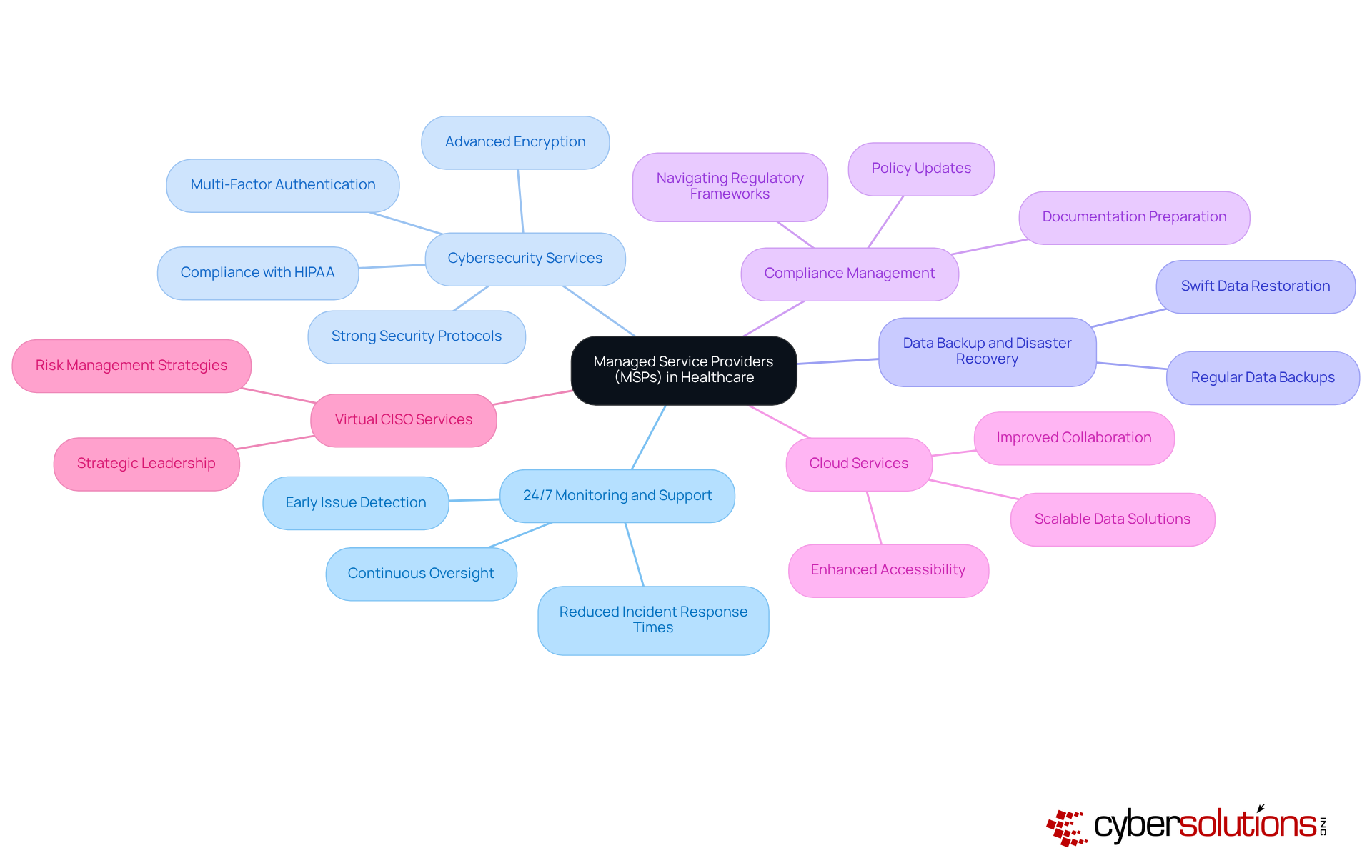
This mindmap starts with MSPs at the center, branching out into the essential services they provide. Each branch represents a different service, and you can explore the details of each one by following the sub-branches.

Discuss Benefits of Partnering with an MSP

In today's rapidly evolving digital landscape, collaborating with a Managed Service Provider (MSP), where MSPs stands for Managed Service Providers, is not just beneficial; it is essential for medical organizations. The significance of cybersecurity in healthcare cannot be overstated, particularly given the unique challenges faced by CFOs in this sector. Key benefits include:

  1. Cost Reduction: Engaging an MSP substantially reduces operational costs by minimizing the need for large in-house IT teams. This transition transforms unpredictable IT expenses into regular monthly costs, facilitating improved budget management and resource allocation towards patient care.
  2. Enhanced Security: MSPs, which stands for Managed Service Providers, offer cybersecurity solutions. With the increasing frequency of cyberattacks, these services are vital for protecting sensitive information and ensuring compliance. Cyber Solutions Inc. provides solutions that adapt to the unique demands of the medical field, safeguarding personal data against threats like ransomware and phishing. Furthermore, Cyber Solutions adopts a Zero Trust approach, guaranteeing that only authorized users gain access to sensitive information.
  3. Focus on Care: By outsourcing IT management to an MSP, which is what MSPs stands for, medical professionals can concentrate on their primary mission—delivering high-quality care. This enables clinical staff to allocate more time to patient interaction and decision-making, ultimately enhancing patient outcomes.
  4. Scalability: Managed Service Providers, which MSPs stands for, offer flexibility in response to the evolving needs of healthcare organizations. Whether integrating new technologies or expanding telehealth capabilities, MSPs can swiftly adapt to support growth without the burden of extensive infrastructure investments.
  5. Expertise and Innovation: Partnering with an MSP, where MSPs stands for Managed Service Providers, provides access to specialized knowledge that may be beyond the reach of in-house teams. This expertise can drive operational improvements, streamline workflows, and elevate the overall quality of care delivered to patients. For instance, Cyber Solutions has successfully implemented strategies that minimize operational disruption, ensuring medical facilities can recover swiftly from potential threats.

In summary, the strategic engagement of an MSP, where MSPs stands for Managed Service Providers, not only addresses immediate operational challenges but also positions healthcare organizations for long-term success in a competitive and complex environment.

This mindmap shows the key benefits of working with an MSP in healthcare. Each branch represents a specific benefit, helping you understand how partnering with an MSP can improve operations and patient care.

Conclusion

Managed Service Providers (MSPs) have become indispensable allies for healthcare organizations, delivering specialized IT management that enables these entities to concentrate on their primary mission: patient care. In an era marked by increasing cybersecurity threats, leveraging the expertise of MSPs allows healthcare CFOs to bolster operational efficiency, ensure compliance with stringent regulations, and safeguard sensitive patient data. This strategic collaboration not only alleviates the burden of in-house IT management but also empowers medical organizations to thrive within an increasingly complex digital landscape.

The multifaceted benefits of MSPs are underscored throughout the article, including cost efficiency, enhanced security, and the ability to scale operations to meet evolving demands. MSPs offer a range of services—from 24/7 monitoring and cybersecurity to compliance management and cloud solutions—tailored to address the unique challenges that healthcare institutions face. By integrating these services, organizations can significantly mitigate operational risks and ensure preparedness for audits and regulatory evaluations.

The escalating reliance on MSPs within the healthcare sector highlights their crucial role in cultivating a secure and efficient operational environment. As the industry continues to evolve, embracing the capabilities of Managed Service Providers is essential for healthcare organizations striving to remain competitive and compliant. Engaging with an MSP is not merely a strategic choice; it is a necessary step toward safeguarding patient information, optimizing resources, and ultimately enhancing the quality of care delivered to patients.

Frequently Asked Questions

What are Managed Service Providers (MSPs)?

Managed Service Providers (MSPs) are specialized external firms that remotely oversee a medical entity's IT infrastructure and end-user systems, providing services such as network management, cybersecurity, data backup, and compliance support.

How do MSPs assist healthcare providers?

MSPs enable healthcare providers to focus on delivering exceptional patient care by managing essential IT functions and reducing the administrative burden associated with in-house management.

Why is compliance important for medical entities?

Compliance is crucial for medical entities to adhere to stringent regulations, such as HIPAA, ensuring the protection of patient health information (PHI) and avoiding potential legal issues.

What specific compliance support do MSPs provide?

MSPs implement robust data protection measures, conduct regular audits, and prepare medical entities for external evaluations, ensuring compliance frameworks are met and exceeded.

How do MSPs enhance cybersecurity for medical organizations?

MSPs, like Cyber Solutions, offer comprehensive HIPAA compliance solutions that include proactive risk management, audit support, and expert guidance to safeguard patient health information.

What are the benefits of outsourcing IT management to MSPs?

Outsourcing IT management to MSPs provides access to specialized expertise, enhances operational effectiveness, and delivers adaptable solutions tailored to the specific needs of medical institutions.

What is the projected growth of the managed services sector?

The managed services sector is projected to approach nearly $350 billion globally by the end of 2024, indicating an increasing reliance on MSPs in healthcare.

How do case studies demonstrate the effectiveness of MSPs?

Case studies show that medical entities utilizing MSPs, like Cyber Solutions, experience improved IT infrastructure management, including assessments to identify compliance gaps and actionable recommendations for security enhancements.

Why are MSPs considered indispensable partners in the medical field?

MSPs empower medical entities to thrive securely in a digital-first environment by providing essential IT management and compliance support, allowing healthcare providers to concentrate on patient care.

List of Sources

  1. Define Managed Service Providers (MSPs)
    • hitconsultant.net (https://hitconsultant.net/2025/09/10/why-healthcare-organizations-are-turning-to-managed-service-providers-msps)
    • managedservicesjournal.com (https://managedservicesjournal.com/articles/how-msps-power-compliance-and-cyber-resilience-in-healthcare)
    • cleardata.com (https://cleardata.com/blog/what-is-healthcare-msp)
    • amnhealthcare.com (https://amnhealthcare.com/amn-insights/managed-services-programs/blog/what-is-an-msp-in-healthcare)
    • Key MSP Statistics and Trends to Know for 2025 (https://jumpcloud.com/blog/msp-statistics-trends)
  2. Explain the Importance of MSPs in Modern Business
    • akraya.com (https://akraya.com/blog/managed-service-partners-a-secure-solution-to-rising-finance-ops-costs)
    • discovercybersolutions.com (https://discovercybersolutions.com/blog-posts/best-practices-for-managed-cyber-security-in-healthcare-cf-os)
    • corsicatech.com (https://corsicatech.com/blog/10-biggest-benefits-of-managed-it-services-for-healthcare-providers)
    • agiliosoftware.com (https://agiliosoftware.com/articles/the-importance-of-managed-services-in-empowering-healthcare-organisations)
    • trustntm.com (https://trustntm.com/how-managed-it-services-are-making-a-difference-in-the-healthcare-industry)
  3. Outline Common Services Provided by MSPs
    • healthtechmagazine.net (https://healthtechmagazine.net/article/2025/07/how-healthcare-organizations-can-pick-right-msp-their-security-needs)
    • hitconsultant.net (https://hitconsultant.net/2025/09/10/why-healthcare-organizations-are-turning-to-managed-service-providers-msps)
    • prnewswire.com (https://prnewswire.com/news-releases/trusted-by-healthcare-leaders-medical-solutions-earns-top-10-msp-spot-for-fourth-year-302447384.html)
    • corsicatech.com (https://corsicatech.com/blog/10-biggest-benefits-of-managed-it-services-for-healthcare-providers)
  4. Discuss Benefits of Partnering with an MSP
    • entremt.com (https://entremt.com/benefits-of-working-with-a-managed-service-provider-msp-in-the-healthcare-industry)
    • corsicatech.com (https://corsicatech.com/blog/10-biggest-benefits-of-managed-it-services-for-healthcare-providers)
    • communication-co.com (https://communication-co.com/news/the-critical-role-of-managed-services-in-healthcare-and-hospitals)
    • Key MSP Statistics and Trends to Know for 2025 (https://jumpcloud.com/blog/msp-statistics-trends)
Recent Posts
Master the CMMC Assessment Guide Level 2 for Effective Compliance
Why Local IT Services Providers Are Key to Business Success
10 Key Benefits of Partnering with IT MSPs for Your Business
Why Healthcare CFOs Should Choose an Outsourced IT Provider
4 Best Practices for CFOs in AI Data Security Compliance
What Is Defense in Depth? Understanding Its Importance for Healthcare CFOs
Essential Corporate Data Backup Practices for Healthcare CFOs
10 Benefits of Outsourced IT Management for Healthcare CFOs
Master Restricting Access: Best Practices for CFOs on OAuth Management
Master Living Off the Land: A CFO's Guide to Sustainability
Master Digital Security Controls for Healthcare CFOs
10 Essential IT Services for Healthcare CFOs to Enhance Security
Master Critical Security Controls for Healthcare CFOs
Best Practices for Managed Cyber Security in Healthcare CFOs
What MSPs Stand For and Why They Matter for Healthcare CFOs
Choosing the Right Managed Cybersecurity Services Provider for CFOs
What Is CMMC Compliance and Why It Matters for Healthcare CFOs
How to Reduce the Risk of Cyber Attack: 4 Essential Steps for CFOs
What Compliance Means: Key Concepts for Healthcare CFOs
5 Best Practices for Achieving CMMC 1.0 Compliance Success
Understanding Cybersecurity as a Service for Healthcare CFOs
Why MSPs in Technology Are Essential for Healthcare CFOs
10 Benefits of Data Security as a Service for Healthcare CFOs
Evaluate 4 Leading Disaster Recovery Software Vendors for Your Business
What IT Services Can Be Outsourced for Business Success?
Enhance Cyber Resilience with Effective External Vulnerability Scanning
Cyber Security Outsourcing Companies vs. In-House Solutions: Key Insights
4 Steps to Optimize Business IT Support for Healthcare CFOs
Understanding Managed Service Provider Costs: Key Factors and Models
Why Fully Managed Services Are Essential for Cybersecurity Success
Understanding the Average Cost of Cybersecurity Services for Leaders
Master Managing Firewalls: Essential Steps for C-Suite Leaders
Master HIPAA Compliant Firewall Requirements for Your Organization
How to Manage Company Laptops: A Step-by-Step Guide for Leaders
6 Best Practices for a Successful Managed Services Strategy
4 Best Practices for Choosing Your NIST Compliance Tool
10 Essential CMMC 2.0 Controls List for Compliance Success
Best Practices for Effective Data Backup Support in Your Organization
4 Essential Cybersecurity Compliance Solutions for C-Suite Leaders
Master Data Backup and Recovery: Best Practices for C-Suite Leaders
Master Two-Factor Authentication for Business: Best Practices Unveiled
Best Practices for Backing Up Your Data Effectively
Enhance Security with Best Practices for Secure Web Browsing
Master 365 Services: Best Practices for Compliance and Efficiency
4 Strong Password Guidelines for C-Suite Leaders to Enhance Security
Essential Backup Information for Compliance and Security Strategies
Business IT Providers vs. In-House IT: Key Comparison for Leaders
Compare Top Two Factor Authentication Service Providers for Your Business
Master HIPAA Compliant Infrastructure: Key Steps for Executives
What LOTL Stands for in Cybersecurity and Its Implications
4 Best Practices for Your Cyber Attack Incident Response Plan
4 Best Practices for Effective Information Technology Spending
Understanding Cyber Security Exercises: Importance and Benefits
5 Best Practices for Optimizing Your Hybrid Work Setting
Understanding Office 365 Meaning: Key Features and Implications
What Office 365 Means for Cyber Solutions Inc.: A Case Study on Transformation
Master Defence in Depth Cyber Security: 5 Steps for C-Suite Leaders
Boost Security Awareness Among Employees with Proven Best Practices
Implement the NIST Incident Response Playbook in 4 Simple Steps
What is a Managed IT Support Service Provider and Why It Matters
Why Data Backup is Important for Business Resilience and Growth
Best Practices for Effective Managed IT Security Solutions
4 Best Practices for Backup & Disaster Recovery Services Success
Best Practices for AI and Machine Learning in Cyber Security
Why USB Malware Threats Matter for C-Suite Leaders Today
What Are Vulnerability Scanners and Why They Matter for Your Business
Create a Disaster Recovery Plan Template for Your Small Business
Master USB Malware: Detect, Prevent, and Educate Your Team
Implementing a Cloud First Approach: A Step-by-Step Guide for Leaders
Compare MS Office or Office 365: Features, Pricing, and Security
Master Dark Web Security Monitoring: Key Practices for C-Suite Leaders
Master CMMC 2.0 Compliance Requirements in 5 Actionable Steps
Master IT Security Assessments: Key Practices for C-Suite Leaders
Why Companies Should Restrict Internet Access: Key Security and Compliance Reasons
10 Essential CMMC Controls List for Compliance Success
Master KPIs for IT: Drive Success with Effective Strategies
9 Essential CMMC Level 3 Controls for C-Suite Leaders
10 Essential CMMC 2.0 Controls for Cybersecurity Success
What Is a Virtual CIO? Understanding Its Role and Benefits for Leaders
Understanding IT Managed Services Contracts: Key Insights for C-Suite Leaders
4 Best Practices to Prevent Attacks on Firewall Security
10 Managed Services Provider Best Practices for C-Suite Leaders
Master Proactive Information Management for Enhanced Security and Efficiency
Enhance Organizational Security: Align Strategies and Manage Risks
Understanding IT Support Cost Per Hour: Key Factors for C-Suite Leaders
Master Cyber Drilling: Best Practices for C-Suite Leaders
Understanding All-Inclusive IT Support: Key Benefits for Leaders
Why All-Inclusive IT Support is Essential for Cybersecurity Success
4 Best Practices for Securing Network Printers Effectively
Understanding TOAD Phishing: A Comparison with Traditional Methods
3 Essential Practices for Printer Network Security in Your Organization
Secure Network Printer: Best Practices for C-Suite Leaders
Enhance Network Printer Security with Proven Best Practices
4 Best Practices for Effective Local IT Solutions Implementation
10 Best Practices for Effective Configuration Management
Understanding Configuration Management Best Practices for Leaders
Understanding Flash Drives and Viruses: Risks and Security Measures
Maximize ROI with Best Practices for Managed Cloud Platforms
10 CMMC Consultants to Ensure Your Compliance Success
4 Best Practices for Developing an Effective Computer Policy