Crafting an Effective Multi-Factor Authentication Policy for Leaders

Crafting an Effective Multi-Factor Authentication Policy for Leaders

Introduction

As cyber threats surge, the need for robust cybersecurity measures in healthcare has reached a critical juncture. Multi-Factor Authentication (MFA) stands out as a vital line of defense, significantly reducing the risk of unauthorized access and data breaches. Organizations often struggle to implement MFA effectively due to user resistance and integration challenges.

What strategies can leaders employ to overcome these hurdles and ensure MFA enhances security while promoting a culture of compliance and vigilance?

Understand the Importance of Multi-Factor Authentication

In an era where cyber threats loom larger than ever, the need for robust cybersecurity measures like Multi-Factor Authentication (MFA) is paramount. MFA is a crucial protective measure that requires users to provide two or more verification factors to access an account, significantly enhancing protection compared to traditional password-only systems. Recent findings indicate that MFA can block 99.9% of account compromise attacks, underscoring its critical role in any cybersecurity strategy, especially for healthcare entities that must comply with HIPAA regulations.

Organizations are confronted with a myriad of threats, including:

  • Phishing attacks
  • Credential theft
  • Unauthorized access

Yet, the challenge of MFA fatigue can hinder user compliance, leading to potential security gaps. Implementing MFA adds an additional layer of security, making it considerably more challenging for attackers to gain access, even if they have compromised a password. This is especially vital for sectors like healthcare and finance, where sensitive information is at stake. Moreover, Cyber Solutions provides extensive HIPAA compliance services that incorporate strong cybersecurity measures, including MFA, to guarantee entities meet the highest standards of data protection. Our services encompass proactive risk management strategies to identify and address vulnerabilities, along with reporting and audit support to keep your entity audit-ready.

Despite these challenges, investing in MFA not only protects data but also improves the entity's overall defense posture and compliance status. The cost of implementing MFA across a small practice is typically under $500, making it a manageable investment for significant security benefits. Without MFA, organizations risk significant data breaches and regulatory penalties. As cyber threats evolve, leaders must prioritize the multi-factor authentication policy as a fundamental component of their cybersecurity framework. Prioritizing the multi-factor authentication policy is not just a choice; it is essential for safeguarding sensitive data and ensuring compliance in an increasingly perilous digital landscape.

This mindmap illustrates the critical role of Multi-Factor Authentication in cybersecurity. Start at the center with MFA, then explore its benefits, the threats it addresses, the challenges organizations face, and its compliance requirements. Each branch represents a key aspect of MFA, helping you see how they all connect to the overarching theme of enhancing security.

Explore Different Types of Multi-Factor Authentication Methods

In an era where cyber threats loom large, the healthcare sector faces unique challenges that demand robust cybersecurity measures, particularly in the multi factor authentication policy. Organizations can implement various MFA methods, each offering distinct advantages and considerations:

  1. Knowledge-based factors: These include passwords or PINs familiar to the individual. While common, they often signify the weakest link in protection due to their vulnerability to breaches.
  2. Possession-based factors: This category encompasses items the user possesses, such as smartphones or hardware tokens. SMS codes and authenticator apps like Google Authenticator are common examples. However, as cyber threats evolve, traditional methods like SMS-based MFA are increasingly inadequate, exposing organizations to significant risks. This has prompted a shift towards more secure alternatives like TOTP apps or hardware-based authenticators.
  3. Inherence-based factors: These involve biometric verifications, such as fingerprints or facial recognition, which offer a high level of security due to their uniqueness and difficulty to replicate. Biometric authentication meets the requirements for phishing-resistant MFA as outlined by regulatory standards, including NIST 800-63B, which is particularly relevant for organizations in regulated industries.
  4. Contextual factors: These examine the context of the login attempt, including the individual's location and device, to ascertain if further verification is required. This adaptive method improves protection by reacting to real-time risk indicators and assists in alleviating problems such as MFA fatigue, where individuals may become overwhelmed by excessive prompts.

It's essential for organizations to assess their unique needs and user habits when selecting the appropriate multi factor authentication policy. For high-risk accounts, businesses may prioritize more secure options like hardware tokens or biometric authentication, which significantly reduce the risk of unauthorized access. As MFA evolves, leveraging a mix of these methods not only strengthens security but also ensures compliance with industry standards. Notably, statistics indicate that 22% of breaches in 2025 were due to credential abuse, underscoring the necessity of robust MFA solutions. With the urgency for organizations to adopt a comprehensive multi factor authentication policy clearer than ever, incorporating expert perspectives and case analyses can guide companies in making informed choices that align with their protection strategies.

This mindmap starts with the central idea of multi-factor authentication and branches out into four main types. Each branch represents a different method, and the sub-branches provide more details about each method's characteristics and examples. This layout helps you understand the various approaches to MFA and how they relate to each other.

Implement Multi-Factor Authentication Effectively

In an era where cyber threats loom large, the healthcare sector must prioritize robust cybersecurity measures to safeguard sensitive patient data. To implement multi-factor authentication (MFA) effectively, organizations should adhere to the following steps:

  1. Assess Current Security Posture: Conduct a thorough evaluation of existing security measures to identify vulnerabilities that MFA can mitigate. This assessment should analyze access patterns and highlight areas needing improvement.
  2. Choose the Right MFA Methods: Select MFA methods that align with the organization's risk profile and participant requirements based on the assessment. Consider user convenience, protection strength, and cost-effectiveness. Emerging trends such as passkeys and phishing-resistant methods should also be taken into account to ensure strong protection.
  3. Develop a Deployment Plan: Formulate a comprehensive plan detailing the implementation process, including timelines, responsibilities, and communication strategies. Engage all stakeholders to ensure alignment and support throughout the rollout.
  4. Educate Employees: Provide training and resources to help employees understand the significance of MFA and how to utilize it effectively. Address any concerns or opposition to change to promote a culture of awareness. Did you know that MFA can block more than 99.2% of account compromise attacks? This statistic reinforces its importance.
  5. Monitor and Adjust: After implementation, continuously monitor MFA effectiveness and gather feedback from participants. Be prepared to make necessary changes to improve both safety and experience for individuals. Furthermore, be mindful of typical traps in the multi-factor authentication policy implementation, such as insufficient training for individuals or neglecting to incorporate the policy into a holistic identity and access management system.

Without a strategic approach to MFA, organizations risk not only their data but also their reputation and trust with patients.

Each box represents a crucial step in implementing MFA. Follow the arrows to see how each step leads to the next, ensuring a comprehensive approach to enhancing cybersecurity in healthcare.

Address Challenges in Multi-Factor Authentication Adoption

Implementing multi-factor authentication (MFA) is essential for enhancing security, yet it comes with its own set of challenges that organizations must navigate:

  1. User Opposition: Many users resist MFA due to its perceived inconvenience, creating a barrier to effective security implementation. To overcome this, organizations should communicate the advantages of MFA clearly, emphasizing its role in protecting sensitive data. Training sessions can ease the transition, helping users feel more comfortable with the technology. This highlights the critical role of effective security education, which can lead to an 82% drop in credential entry after phishing attempts.
  2. Integration Issues: Integrating MFA with existing systems can be complex. It's crucial for organizations to pick MFA solutions that work seamlessly with their existing applications and infrastructure. Conducting a thorough compatibility assessment before implementation can help mitigate integration challenges. Additionally, adaptive MFA can provide a more flexible integration approach, easing the process.
  3. Cost Concerns: Some entities may worry about the costs associated with implementing MFA. However, while initial costs may seem daunting, the long-term savings from preventing breaches can significantly outweigh these expenses. The financial penalties and reputational damage from a data breach can be substantial. Leaders should view MFA as a long-term investment in protection that can yield significant returns.
  4. User Experience: Balancing protection with user experience is crucial. Organizations should choose MFA methods that are user-friendly and minimize friction during the login process. For example, adaptive MFA can offer a seamless experience by requiring extra verification only in high-risk situations, thereby improving protection without sacrificing usability.

By addressing these challenges head-on, organizations not only enhance their security posture but also empower their workforce to embrace a culture of vigilance and protection.
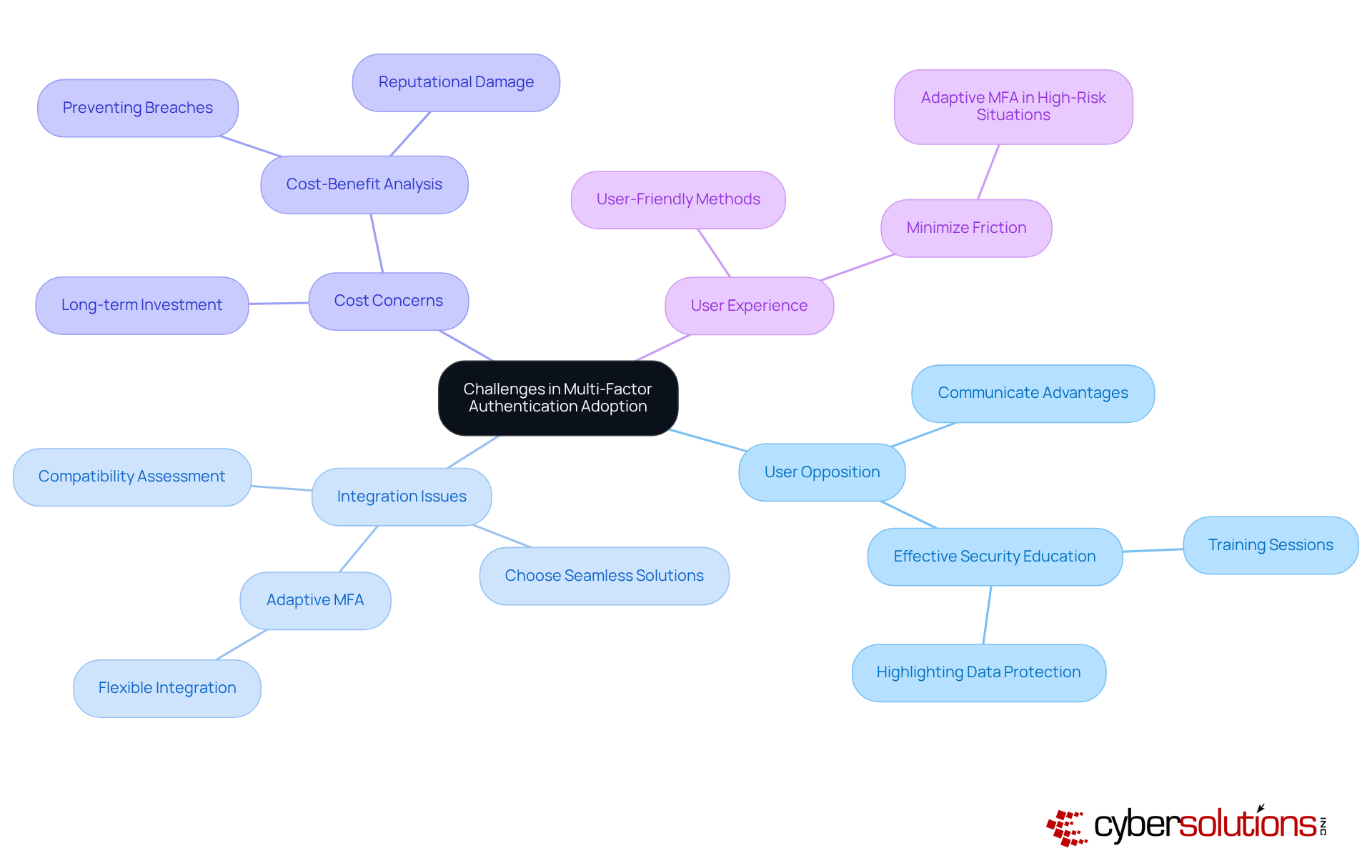
The central node represents the main topic of MFA challenges. Each branch highlights a specific challenge, and the sub-branches provide solutions or considerations for overcoming those challenges. This layout helps visualize how organizations can tackle the complexities of MFA adoption.

Conclusion

In an era where cyber threats are escalating, the implementation of a comprehensive multi-factor authentication (MFA) policy is no longer optional. As organizations are grappling with escalating cyber threats that demand immediate action, MFA serves as a vital defense mechanism that significantly enhances security. This policy is essential for protecting sensitive data and meeting regulatory requirements, especially in healthcare and finance.

This article has highlighted key insights about why MFA is crucial, the various methods available, and the steps organizations can take to implement it effectively. From understanding the different types of authentication factors to addressing user resistance and integration challenges, a strategic approach is essential. The benefits of MFA, including its ability to block a staggering 99.9% of account compromise attacks, underscore its critical role in any cybersecurity framework. Moreover, the investment in MFA is manageable compared to the potential costs associated with data breaches and regulatory penalties.

The message is unmistakable: organizations must make the development and execution of a robust multi-factor authentication policy a top priority. By doing so, they not only protect their sensitive information but also cultivate a proactive security culture that is essential in today’s digital landscape. As cyber threats continue to evolve, embracing MFA as an integral part of the cybersecurity strategy is essential for ensuring long-term resilience and trust.

Frequently Asked Questions

What is Multi-Factor Authentication (MFA)?

Multi-Factor Authentication (MFA) is a security measure that requires users to provide two or more verification factors to access an account, enhancing protection compared to traditional password-only systems.

How effective is MFA in preventing account compromise?

MFA can block 99.9% of account compromise attacks, highlighting its critical role in cybersecurity strategies.

Why is MFA particularly important for healthcare entities?

MFA is essential for healthcare entities to comply with HIPAA regulations and to protect sensitive information from cyber threats.

What types of threats can MFA help protect against?

MFA helps protect against threats such as phishing attacks, credential theft, and unauthorized access.

What is MFA fatigue and how does it affect user compliance?

MFA fatigue refers to the challenge users face in consistently using MFA, which can lead to non-compliance and potential security gaps.

What are the benefits of implementing MFA in organizations?

Implementing MFA adds an extra layer of security, making it more difficult for attackers to gain access, thus improving overall defense posture and compliance status.

What is the typical cost of implementing MFA in a small practice?

The cost of implementing MFA across a small practice is typically under $500, making it a manageable investment for significant security benefits.

What risks do organizations face without MFA?

Without MFA, organizations risk significant data breaches and regulatory penalties.

Why should leaders prioritize MFA in their cybersecurity framework?

Leaders must prioritize MFA as it is essential for safeguarding sensitive data and ensuring compliance in an increasingly perilous digital landscape.

List of Sources

  1. Understand the Importance of Multi-Factor Authentication
    • Major Cyber Attacks in February 2026: BQTLock, Thread-Hijack Phishing, and MFA Bypass Evolution (https://linkedin.com/pulse/major-cyber-attacks-february-2026-bqtlock-thread-hijack-4fdlc)
    • HIPAA MFA Requirements in 2026: Multi-Factor Authentication Mandate Explained | Medcurity (https://medcurity.com/hipaa-mfa-requirements-2026)
    • Authentication in 2026 - moving beyond foundational MFA to tackle the new era of attacks (https://techradar.com/pro/authentication-in-2026-moving-beyond-foundational-mfa-to-tackle-the-new-era-of-attacks)
    • Multi-Factor Authentication: 2026 Guide to Stronger Security - Proximia (https://proximia.com/blog/multi-factor-authentication-2026-guide-to-stronger-security)
    • Cyber Essentials 2026: Mandatory MFA on ALL cloud services (https://pushsecurity.com/blog/cyber-essentials-april-2026-update)
  2. Explore Different Types of Multi-Factor Authentication Methods
    • Top 10 Multifactor Authentication Solutions for 2026 (https://secureitworld.com/article/top-10-multifactor-authentication-solutions-to-prevent-unauthorized-access)
    • Multi-Factor Authentication: 2026 Guide to Stronger Security - Proximia (https://proximia.com/blog/multi-factor-authentication-2026-guide-to-stronger-security)
    • MFA Best Practices 2026: From Basics to Being Phishing-Resistant (https://miniorange.com/blog/multi-factor-authentication-mfa-best-practices)
    • 10 Multi-factor Authentication Trends To Adopt in 2026 | OLOID (https://oloid.com/blog/future-trends-in-multi-factor-authentication-what-to-expect)
    • MFA Methods Compared: SMS, Authenticator & Biometrics (2026) (https://gcstechnologies.com/choose-the-right-mfa-method-for-your-security)
  3. Implement Multi-Factor Authentication Effectively
    • Why Your MFA Can Still Be Hacked (How I’d Implement MFA in 2026) (https://blog.cloudcapsule.io/blog/why-your-mfa-can-still-be-hacked-how-id-implement-mfa-in-2026)
    • How to implement multifactor authentication (MFA) | IBM (https://ibm.com/think/topics/mfa-implementation)
    • How Should You Implement MFA in 2026? | Managed IT Services & Tech Support in West Michigan (https://hungerford.tech/blog/how-should-you-implement-mfa-in-2026)
    • 10 Multi-factor Authentication Trends To Adopt in 2026 | OLOID (https://oloid.com/blog/future-trends-in-multi-factor-authentication-what-to-expect)
    • 7 Reasons Why You Need MFA Security in 2026 (https://splashtop.com/blog/why-you-need-MFA-security)
  4. Address Challenges in Multi-Factor Authentication Adoption
    • Multi-Factor Authentication: 2026 Guide to Stronger Security - Proximia (https://proximia.com/blog/multi-factor-authentication-2026-guide-to-stronger-security)
    • World Password Day 2026: The Credential Crisis Hasn’t Gone Away, It’s Just Got More Dangerous (https://itsecurityguru.org/2026/05/07/world-password-day-2026-the-credential-crisis-hasnt-gone-away-its-just-got-more-dangerous)
    • How Should You Implement MFA in 2026? | Managed IT Services & Tech Support in West Michigan (https://hungerford.tech/blog/how-should-you-implement-mfa-in-2026)
    • MFA Best Practices 2026: From Basics to Being Phishing-Resistant (https://miniorange.com/blog/multi-factor-authentication-mfa-best-practices)
    • Why SMS MFA No Longer Cuts It in 2026 - Decypher Technologies (https://decyphertech.com/why-sms-mfa-no-longer-cuts-it-in-2026)
Recent Posts
Achieve CMMC 3.0 Compliance: A Step-by-Step Guide for Leaders
Achieve Regulatory Compliance: Strategies for C-Suite Leaders
10 Key Components of an Effective IT Backup and Disaster Recovery Plan
Crafting an Effective Multi-Factor Authentication Policy for Leaders
10 Essential IT KPI Examples for C-Suite Leaders to Track
4 Essential Practices for Effective Disaster Recovery Plans for Businesses
4 Best Practices for Effective RPO Backup Implementation
4 Proven Strategies for Effective Breach Prevention in Business
5 Essential CMMC Documentation Steps for Compliance Success
Master DR and RPO: Best Practices for C-Suite Leaders
Explain the Importance of Data Backup for Business Resilience
4 Best Practices for Choosing Information Security Services Companies
What Does It Mean to Be in Compliance? Key Insights for Leaders
Boost Operational Efficiency with Managed IT Services Mobile
4 Best Practices for Effective Cyber Security Evaluation
Understand Adware and Spyware: Protect Your Business Today
IT Policy for Company: Key Components and Industry Challenges
Best Practices for Choosing Your EDR Provider Effectively
Optimize Your Disaster Recovery Plan for Time and Cost Efficiency
What to Do If You Get Phished: Essential Strategies for Leaders
Master CMMC Processes: Essential Best Practices for Compliance Success
4 Best Practices for Advanced Threat Analysis in Cybersecurity
What Is Anti-Phishing Software and Why It Matters for Your Business
4 Steps to Master the Vulnerability Scanning Process for Security
What Expense Should You Expect When Buying a New Firewall?
Master the FTC Safeguards Rule for Your Risk Assessment Template
Master NIST 800-171 Compliance Audit in 6 Essential Steps
Master Managed Services Projects: Key Strategies for C-Suite Leaders
Master FTC MFA Requirements: A Step-by-Step Guide for Leaders
Enhance Password Compliance with These 4 Essential Strategies
10 Key Factors Influencing Network Firewall Pricing for Executives
4 Best Practices for Effective Firewall Testing and Security
Master the CMMC Assessment Guide Level 2 for Effective Compliance
Why Local IT Services Providers Are Key to Business Success
10 Key Benefits of Partnering with IT MSPs for Your Business
Why Healthcare CFOs Should Choose an Outsourced IT Provider
4 Best Practices for CFOs in AI Data Security Compliance
What Is Defense in Depth? Understanding Its Importance for Healthcare CFOs
Essential Corporate Data Backup Practices for Healthcare CFOs
10 Benefits of Outsourced IT Management for Healthcare CFOs
Master Restricting Access: Best Practices for CFOs on OAuth Management
Master Living Off the Land: A CFO's Guide to Sustainability
Master Digital Security Controls for Healthcare CFOs
10 Essential IT Services for Healthcare CFOs to Enhance Security
Master Critical Security Controls for Healthcare CFOs
Best Practices for Managed Cyber Security in Healthcare CFOs
What MSPs Stand For and Why They Matter for Healthcare CFOs
Choosing the Right Managed Cybersecurity Services Provider for CFOs
What Is CMMC Compliance and Why It Matters for Healthcare CFOs
How to Reduce the Risk of Cyber Attack: 4 Essential Steps for CFOs
What Compliance Means: Key Concepts for Healthcare CFOs
5 Best Practices for Achieving CMMC 1.0 Compliance Success
Understanding Cybersecurity as a Service for Healthcare CFOs
Why MSPs in Technology Are Essential for Healthcare CFOs
10 Benefits of Data Security as a Service for Healthcare CFOs
Evaluate 4 Leading Disaster Recovery Software Vendors for Your Business
What IT Services Can Be Outsourced for Business Success?
Enhance Cyber Resilience with Effective External Vulnerability Scanning
Cyber Security Outsourcing Companies vs. In-House Solutions: Key Insights
4 Steps to Optimize Business IT Support for Healthcare CFOs
Understanding Managed Service Provider Costs: Key Factors and Models
Why Fully Managed Services Are Essential for Cybersecurity Success
Understanding the Average Cost of Cybersecurity Services for Leaders
Master Managing Firewalls: Essential Steps for C-Suite Leaders
Master HIPAA Compliant Firewall Requirements for Your Organization
How to Manage Company Laptops: A Step-by-Step Guide for Leaders
6 Best Practices for a Successful Managed Services Strategy
4 Best Practices for Choosing Your NIST Compliance Tool
10 Essential CMMC 2.0 Controls List for Compliance Success
Best Practices for Effective Data Backup Support in Your Organization
4 Essential Cybersecurity Compliance Solutions for C-Suite Leaders
Master Data Backup and Recovery: Best Practices for C-Suite Leaders
Master Two-Factor Authentication for Business: Best Practices Unveiled
Best Practices for Backing Up Your Data Effectively
Enhance Security with Best Practices for Secure Web Browsing
Master 365 Services: Best Practices for Compliance and Efficiency
4 Strong Password Guidelines for C-Suite Leaders to Enhance Security
Essential Backup Information for Compliance and Security Strategies
Business IT Providers vs. In-House IT: Key Comparison for Leaders
Compare Top Two Factor Authentication Service Providers for Your Business
Master HIPAA Compliant Infrastructure: Key Steps for Executives
What LOTL Stands for in Cybersecurity and Its Implications
4 Best Practices for Your Cyber Attack Incident Response Plan
4 Best Practices for Effective Information Technology Spending
Understanding Cyber Security Exercises: Importance and Benefits
5 Best Practices for Optimizing Your Hybrid Work Setting
Understanding Office 365 Meaning: Key Features and Implications
What Office 365 Means for Cyber Solutions Inc.: A Case Study on Transformation
Master Defence in Depth Cyber Security: 5 Steps for C-Suite Leaders
Boost Security Awareness Among Employees with Proven Best Practices
Implement the NIST Incident Response Playbook in 4 Simple Steps
What is a Managed IT Support Service Provider and Why It Matters
Why Data Backup is Important for Business Resilience and Growth
Best Practices for Effective Managed IT Security Solutions
4 Best Practices for Backup & Disaster Recovery Services Success
Best Practices for AI and Machine Learning in Cyber Security
Why USB Malware Threats Matter for C-Suite Leaders Today
What Are Vulnerability Scanners and Why They Matter for Your Business
Create a Disaster Recovery Plan Template for Your Small Business
Master USB Malware: Detect, Prevent, and Educate Your Team