Introduction
In the rapidly evolving landscape of healthcare, cybersecurity is not just an IT issue; it's a critical business imperative that demands immediate attention. As threats become increasingly sophisticated, the effectiveness of IT services in healthcare is paramount. Organizations must navigate a complex landscape of compliance, operational efficiency, and technological integration to safeguard sensitive data and enhance service delivery.
So, what strategies can we adopt to ensure our IT services not only tackle today’s challenges but also prepare us for tomorrow?
Let’s dive into the essential strategies for:
- Assessing your organization’s needs
- Choosing the right service providers
- Seamlessly integrating IT solutions into your workflows
This way, your business can thrive securely in this digital age. Without a proactive approach to cybersecurity, healthcare organizations risk not only their data but also their reputation and operational viability.
Assess Organizational Needs for IT Services
In an era where cybersecurity threats loom large, healthcare organizations must prioritize robust IT infrastructure to safeguard sensitive patient data. To effectively assess organizational requirements for IT resources, begin with a thorough evaluation of your current IT setup, including hardware, software, and network capabilities. Engage stakeholders across departments to gather insights on their specific challenges and requirements. Tools like surveys or interviews can help collect valuable data on user experiences and expectations.
This assessment should also consider how your IT solutions can grow and adapt as your organization evolves. By identifying critical areas for improvement, organizations can prioritize investments in IT services that deliver the most value and enhance operational efficiency.
For instance, a healthcare organization may discover that its current data management systems are insufficient for adhering to HIPAA regulations. By acknowledging this need, they can implement targeted IT solutions that not only satisfy regulatory requirements but also enhance patient data security and accessibility. This proactive approach minimizes risks and enhances overall organizational resilience. By taking decisive action now, organizations can not only protect themselves from potential breaches but also position themselves for future growth and success.

Choose the Right IT Service Provider
In an era where cyber threats loom large, selecting the right IT services commercial provider can make or break your organization's security posture. Selecting the appropriate IT services commercial entity is essential for ensuring regulations and security in today's digital environment. Start by evaluating Cyber Solutions' industry expertise, particularly their experience with compliance frameworks and security measures relevant to your sector. Certifications such as HIPAA for healthcare or PCI-DSS for financial institutions are essential indicators of an entity's credibility and capability in safeguarding sensitive data.
It's crucial to assess how scalable and flexible IT services commercial are to meet your evolving needs. As your business grows, your IT requirements will change, and your chosen partner for IT services commercial must adapt seamlessly. Review their service level agreements (SLAs) to ensure they align with your expectations for response times and support availability.
Consider that 60% of financial institutions report data breaches due to inadequate cybersecurity measures, making it essential to prioritize IT services commercial that have proven protocols. Cyber Solutions offers comprehensive Compliance as a Service (CaaS), which includes risk assessments, policy development, and ongoing compliance monitoring to ensure adherence to standards like HIPAA, PCI-DSS, GDPR, SOX, and CMMC. Furthermore, their Incident Response solutions are designed to rapidly identify, contain, and mitigate threats, restoring systems and ensuring business continuity.
Downtime in the IT industry costs approximately $5,600 per minute, highlighting the financial consequences of selecting the right IT services commercial partner. Choosing the wrong IT services commercial can expose your organization to compliance failures and significant financial losses. By partnering with Cyber Solutions, you not only safeguard your data but also position your organization for sustainable growth in a secure environment.

Integrate IT Services into Existing Workflows
In an era where cybersecurity threats loom large, the integration of IT resources into healthcare workflows is not just beneficial - it's essential for safeguarding operations and enhancing efficiency. Start by examining your current processes - where can technology step in to make things run smoother? Collaborate with department heads to understand their workflows and pain points, ensuring that IT solutions are designed to address specific needs.
Consider automation tools; they can take care of repetitive tasks, allowing your team to concentrate on what truly matters - enhancing patient care and operational efficiency. For instance, integrating a help desk ticketing system can improve response times and enhance user satisfaction by providing a structured approach to IT support.
Don’t forget about training - equipping your staff with the right knowledge on new systems is crucial for a smooth transition and successful adoption. By fostering a culture of collaboration between IT and operational teams, organizations can create a more cohesive and efficient working environment. Ultimately, the success of integrating IT services commercially hinges on a proactive approach that prioritizes collaboration and continuous improvement, ensuring that healthcare organizations remain resilient in the face of evolving challenges.

Monitor and Evaluate IT Service Performance
In an era where cybersecurity threats loom large, the need for robust IT performance monitoring in healthcare has never been more critical. Monitoring and evaluating IT performance should be an ongoing process. Establish key performance indicators (KPIs) that align with your organizational goals, such as:
- Response times
- Resolution rates
- User satisfaction scores
For financial institutions, KPIs might include:
- The average time to resolve incidents
- The percentage of successful transactions processed without issues
In healthcare, metrics such as patient portal adoption rates and electronic health record (EHR) utilization can offer insights into effectiveness and user engagement. Additionally, consider a third KPI related to business outcomes, such as the impact of IT issues on production lines in manufacturing or patient outcomes in healthcare.
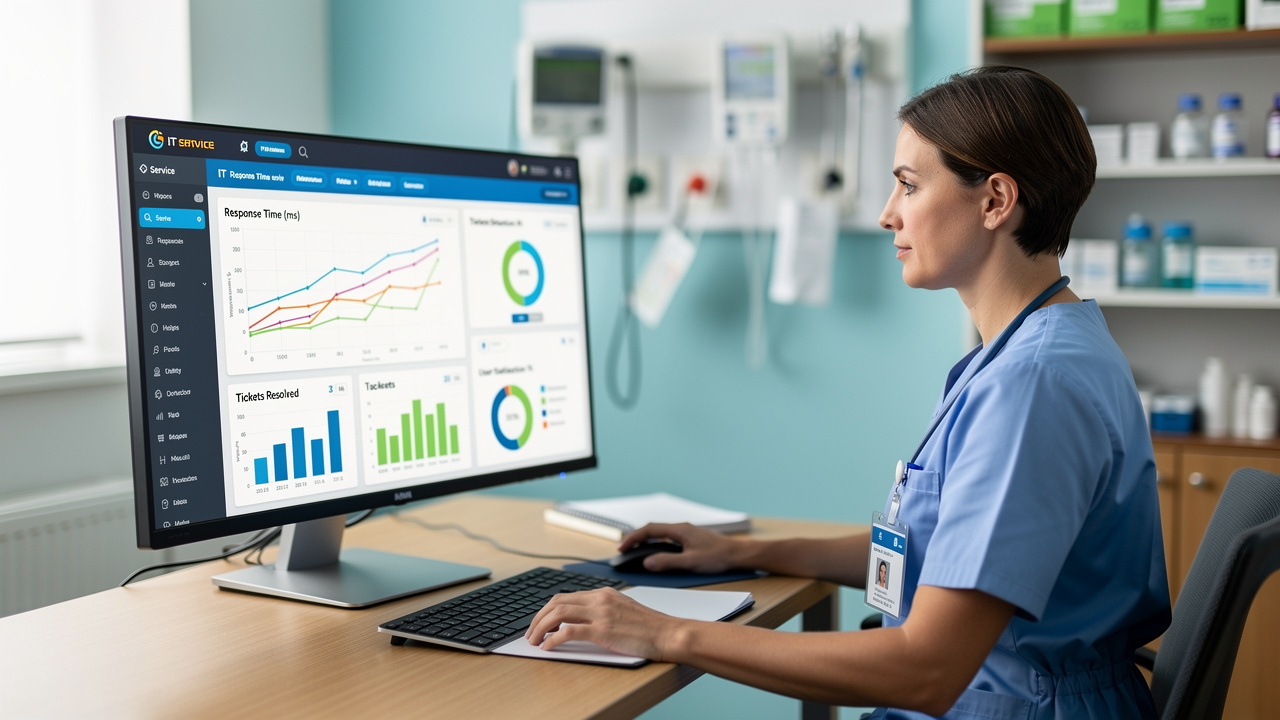
By regularly reviewing these metrics, organizations can spot trends and identify areas for improvement. It's crucial to implement tools that offer real-time analytics and reporting to manage IT operations proactively. For example, a customizable dashboard that monitors performance can assist IT teams in swiftly identifying and resolving problems before they intensify. Establishing baselines and tracking drift is essential to reduce alert fatigue and anticipate failures.
How often do you gather feedback from users about their IT support experiences? Conducting regular feedback sessions with users can provide valuable insights into their experiences with IT support. This feedback can guide modifications and improvements to delivery, ensuring that IT remains in sync with business goals. Notably, in 2022, 48% of negative feedback from end-users indicated that their tickets were not solved, underscoring the importance of effective monitoring. By fostering a culture of accountability and continuous improvement, organizations can enhance IT service effectiveness and drive better business outcomes, all while ensuring robust cybersecurity measures are in place. Furthermore, maintaining patch management compliance is vital for addressing vulnerabilities and safeguarding sensitive data. Ultimately, neglecting these practices could leave organizations vulnerable to cyber threats and hinder their operational efficiency.

Conclusion
In an era where cyber threats are increasingly sophisticated, the need for effective IT services has never been more critical. Implementing robust IT services in commercial settings is essential for organizations looking to enhance operational efficiency and protect sensitive data. Businesses can create a resilient infrastructure by:
- Strategically assessing their needs
- Choosing the right IT service provider
- Integrating solutions into workflows
- Continuously monitoring performance
The article underscores the importance of thoroughly evaluating IT requirements to ensure that organizations invest in solutions that genuinely address their unique challenges. Key arguments highlight the significance of:
- Selecting a provider with a proven track record in compliance and security
- Seamlessly integrating IT services into daily operations
- Fostering a culture of ongoing performance evaluation
However, many organizations struggle to keep pace with the rapidly evolving threat landscape. These practices help reduce risks and enable organizations to tackle evolving cybersecurity threats head-on.
In conclusion, prioritizing robust IT services is a strategic imperative for organizations in sectors like healthcare, finance, and manufacturing. By embracing these best practices, businesses can cultivate a secure and efficient operational environment that positions them for sustainable growth. By taking decisive action now, organizations can not only protect their assets but also secure their future in a digital-first world.
Frequently Asked Questions
Why is it important for healthcare organizations to assess their IT needs?
It is crucial for healthcare organizations to assess their IT needs to safeguard sensitive patient data against cybersecurity threats and ensure compliance with regulations like HIPAA.
What steps should organizations take to evaluate their current IT setup?
Organizations should conduct a thorough evaluation of their current IT infrastructure, including hardware, software, and network capabilities, and engage stakeholders across departments to gather insights on specific challenges and requirements.
How can organizations collect data on user experiences and expectations?
Organizations can use tools such as surveys or interviews to collect valuable data on user experiences and expectations regarding their IT services.
What should organizations consider regarding the adaptability of their IT solutions?
Organizations should consider how their IT solutions can grow and adapt as the organization evolves, ensuring that they can meet future challenges and demands.
What are the benefits of identifying critical areas for IT improvement?
By identifying critical areas for improvement, organizations can prioritize investments in IT services that deliver the most value, enhance operational efficiency, and strengthen overall organizational resilience.
Can you provide an example of how assessing IT needs can lead to better compliance?
For instance, a healthcare organization may find that its data management systems do not meet HIPAA regulations. By recognizing this need, they can implement targeted IT solutions that enhance data security and accessibility, ensuring compliance and protecting patient information.
What proactive measures can organizations take to minimize risks related to cybersecurity?
Organizations can take decisive action to enhance their IT infrastructure, thereby protecting against potential breaches and positioning themselves for future growth and success.
List of Sources
- Choose the Right IT Service Provider
- How to Choose a Fully Managed IT Provider in 2026 (https://compassmsp.com/resources/articles/how-to-choose-a-fully-managed-it-provider-in-2026)
- Managed Services Provider Statistics and Facts (2026) (https://scoop.market.us/managed-services-statistics)
- The Key Criteria for Choosing a Managed Service Provider in 2026 (https://blueally.com/the-key-criteria-for-choosing-a-managed-service-provider-in-2026)
- Top 50 IT Service Providers in 2026 (https://dakotaridgemarketing.com/post/50-it-service-provider-statistics-for-2023-and-beyond)
- 5 Key Considerations When Choosing an IT service provider - Nordlo (https://nordlo.com/en/knowledge-post/5-important-things-to-consider-when-choosing-an-it-supplier)
- Integrate IT Services into Existing Workflows
- 8 Ways Healthcare Workflow Automation Improves Patient Care (https://boomi.com/blog/healthcare-workflow-automation)
- Enhance Existing Investments with Workflow Optimization (https://healthtechmagazine.net/article/2024/07/enhance-existing-investments-workflow-optimization)
- Why 2025 is the Year Healthcare Finally Gets Workflow Automation Right | CSI Companies (https://csicompanies.com/insights/why-2025-is-the-year-healthcare-finally-gets-workflow-automation-right)
- The future of integrated healthcare workflow: Delivering on the promises of the EHR dream (https://wolterskluwer.com/en/expert-insights/future-of-integrated-healthcare-workflow-delivering-on-promises-of-ehr-dream)
- Monitor and Evaluate IT Service Performance
- Mastering UDS+ Implementation and Reporting with NextGen HER (https://dashealth.com/blog/5-it-kpis-you-should-track-for-better-efficiency)
- 24 Strategic KPIs for IT Departments | LogMeIn (https://logmein.com/blog/6-strategic-kpis-for-your-it-department)
- IT Service Desk Metrics and KPIs: Measuring What Really Matters (https://itsm.tools/it-service-desk-metrics-three-kpis)
- The ultimate guide to IT monitoring tools in 2026 | NetApp (https://netapp.com/learn/it-monitoring-tools-guide-2026)
- 2026 Network Monitoring Trends: What’s Changing and Why It Matters - AKIPS (https://akips.com/blog/2026-network-monitoring-trends)