
Master HIPAA Compliant Firewall Requirements for Your Organization

Master HIPAA Compliant Firewall Requirements for Your Organization

Introduction

In an era where data breaches are increasingly common, the stakes for healthcare organizations have never been higher when it comes to cybersecurity and HIPAA compliance. HIPAA sets forth essential guidelines to protect sensitive patient information, and at the heart of this compliance lies the necessity for robust firewall management. As cyber threats grow more sophisticated, healthcare organizations face mounting pressure to protect sensitive patient data effectively.

How can they ensure their firewalls not only meet HIPAA requirements but also defend against unauthorized access? Let’s explore the essential components of HIPAA compliant firewall requirements and discover best practices to enhance cybersecurity in the healthcare sector.

Clarify HIPAA Compliance Fundamentals

In an era where healthcare data breaches are on the rise, understanding HIPAA compliance is not just important - it's essential for safeguarding patient information. HIPAA, or the Health Insurance Portability and Accountability Act, establishes national standards for the protection of health information. For any entity dealing with protected health information (PHI), grasping its core components is crucial. The key elements of HIPAA compliance include:

  1. Privacy Rule: This rule governs the use and disclosure of PHI, ensuring that individuals' health information remains confidential. It requires that entities obtain patient consent for the use of their data and provides patients with rights regarding their health information.
  2. Security Rule: This rule outlines the necessary technical, administrative, and physical safeguards to protect electronic PHI (ePHI). Organizations must implement measures such as encryption, access controls, and regular security audits to mitigate risks associated with unauthorized access.
  3. Breach Notification Rule: In the event of a data breach, entities are required to notify affected individuals and the Department of Health and Human Services (HHS). This rule emphasizes the importance of timely communication and transparency in maintaining trust with patients.
  4. Enforcement Rule: This rule provides guidelines for compliance and outlines penalties for violations. With increased scrutiny in 2026, entities must ensure they are prepared for potential audits and enforcement actions.

Understanding these essentials is crucial because they directly influence how firewalls are set up and managed to comply with HIPAA compliant firewall requirements, serving as a frontline defense against unauthorized access to sensitive health data. As cybersecurity threats evolve, organizations must prioritize adherence to HIPAA to protect patient information and avoid substantial penalties. Without a robust understanding of HIPAA, healthcare organizations risk not only patient trust but also their very operational integrity.

This mindmap starts with the central idea of HIPAA compliance and branches out into its key components. Each branch represents a rule that is essential for protecting patient information, with further details provided in the sub-branches. Follow the branches to understand how each rule contributes to overall compliance.

Outline HIPAA Firewall Requirements

In an era where cyber threats are increasingly sophisticated, the healthcare sector must prioritize cybersecurity to protect sensitive patient information. To keep ePHI safe, firewalls must adhere to HIPAA compliant firewall requirements by enforcing strict access rules, ensuring that only authorized personnel can view sensitive information. Implementing role-based permissions and considering multi-factor authentication (MFA) can significantly enhance protection.

Keeping detailed logs of who accesses what and when is crucial for spotting potential breaches and staying compliant. This practice not only supports compliance but also strengthens overall safety monitoring. Organizations should establish a routine for reviewing logs and documenting follow-up actions to demonstrate adherence to security policies.

Data transmitted over the network must be encrypted to safeguard against interception. Firewalls should support secure communication protocols such as SSL/TLS, ensuring that ePHI remains confidential during transmission. Regular assessments of encryption methods can help organizations stay ahead of potential vulnerabilities.

Effective network segmentation is crucial for isolating ePHI from less secure areas, thereby reducing the risk of unauthorized access. This practice helps contain potential breaches and limits exposure. Organizations should conduct regular vulnerability scans to identify areas needing segmentation improvements.

To adhere to HIPAA compliant firewall requirements, firewalls must be regularly updated to defend against emerging vulnerabilities. This includes timely application of patches and updates to both hardware and software components, ensuring robust protection against threats. Neglecting these updates could expose organizations to significant regulatory penalties and data breaches.

By adhering to these requirements and implementing proactive strategies, healthcare organizations not only comply with HIPAA but also fortify their defenses against the ever-evolving landscape of cyber threats.

This flowchart shows the essential steps healthcare organizations should take to comply with HIPAA firewall requirements. Each box represents a key action, and the arrows guide you through the process of enhancing cybersecurity measures.

Implement Best Practices for Firewall Management

In an era where healthcare data breaches are on the rise, managing firewalls effectively is not just a regulatory requirement; it's a critical component of safeguarding patient information. To effectively manage firewalls in a HIPAA-compliant manner, organizations should adopt the following best practices:

  1. Establish a Firewall Policy: Create a detailed firewall policy that clearly defines rules and procedures for managing configurations and control of entry. This policy should reflect the latest regulatory expectations and incorporate lessons learned from past incidents, ensuring alignment with Cyber Solutions' Compliance as a Service (CaaS).
  2. Regular Audits: How often do you assess your firewall configurations? Regular audits are essential for ensuring HIPAA compliance and verifying that we meet the HIPAA compliant firewall requirements to detect unauthorized access attempts. In 2026, 97% of organizations are expected to conduct at least two audits annually, underscoring the importance of maintaining rigorous oversight. Cyber Solutions can assist in this process through its CaaS offerings.
  3. User Training: Offer continuous training for personnel on the importance of firewall protection and the specific policies implemented. This training fosters a culture of compliance and vigilance, which is crucial as 60% of risk and compliance professionals plan to include cybersecurity in training topics over the next few years. Cyber Solutions offers resources to support this training initiative.
  4. Incident Response Plan: Is your incident response plan ready for a breach? It should detail how to respond to firewall alerts and unauthorized access attempts, enabling swift action to mitigate risks. Cyber Solutions' Incident Response services can help organizations rapidly identify, contain, and mitigate threats, ensuring business continuity.
  5. Utilize Advanced Features: Leverage advanced firewall features such as intrusion detection systems (IDS) and intrusion prevention systems (IPS) to enhance security. These tools are essential for identifying and preventing potential threats in real-time, aligning with the trend of incorporating technology into regulatory practices. Cyber Solutions' CaaS can assist in ongoing compliance monitoring, ensuring that your firewall management adheres to HIPAA compliant firewall requirements.

By prioritizing these best practices, organizations can not only comply with HIPAA but also fortify their defenses against the ever-evolving landscape of cyber threats.
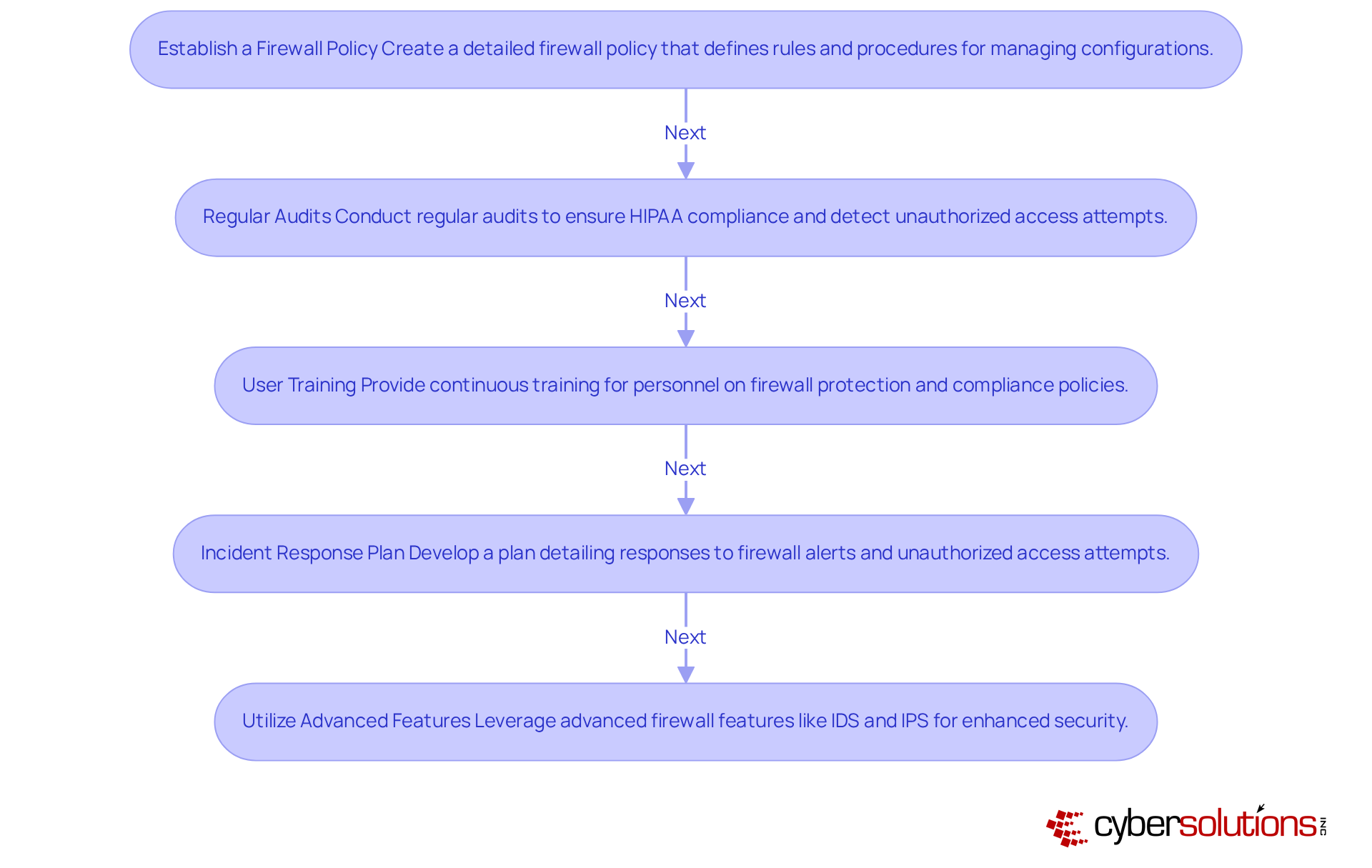
Each box in the flowchart represents a key practice for managing firewalls effectively. Follow the arrows to see the recommended order of implementation. This visual guide helps ensure that organizations can enhance their firewall management and comply with HIPAA regulations.

Conclusion

In an era where cyber threats are increasingly sophisticated, understanding HIPAA compliant firewall requirements is not just important; it's essential for safeguarding patient data. The significance of protecting patient information is paramount; non-compliance can result in severe penalties and erode trust. By grasping the fundamentals of HIPAA compliance, organizations can establish robust firewalls that serve as a primary defense against unauthorized access to sensitive information.

We’ve explored several key components of HIPAA compliance that are crucial for your organization, including the following:

  1. Privacy Rule
  2. Security Rule
  3. Breach Notification Rule
  4. Enforcement Rule

Each of these elements plays a vital role in shaping the firewall requirements necessary to protect electronic PHI. Additionally, best practices for firewall management, such as the following, are essential strategies that organizations must adopt to enhance their cybersecurity posture:

  • Regular audits
  • User training
  • Leveraging advanced features

The evolving landscape of cyber threats necessitates a proactive approach to HIPAA compliance. Many organizations struggle to keep up with the evolving regulations and threats. Organizations must prioritize the implementation of these firewall requirements and best practices to not only meet regulatory standards but also ensure the safety and confidentiality of patient information. Failure to comply not only risks penalties but also jeopardizes patient trust and safety. By prioritizing these firewall requirements, healthcare organizations can not only comply with regulations but also build a fortress around patient trust and data integrity.

Frequently Asked Questions

What is HIPAA and why is it important?

HIPAA, or the Health Insurance Portability and Accountability Act, establishes national standards for the protection of health information, making it essential for safeguarding patient information in the face of rising healthcare data breaches.

What are the key components of HIPAA compliance?

The key components of HIPAA compliance include the Privacy Rule, Security Rule, Breach Notification Rule, and Enforcement Rule.

What does the Privacy Rule entail?

The Privacy Rule governs the use and disclosure of protected health information (PHI), ensuring confidentiality and requiring entities to obtain patient consent for data use while providing patients with rights regarding their health information.

What is the purpose of the Security Rule?

The Security Rule outlines the necessary technical, administrative, and physical safeguards to protect electronic PHI (ePHI), requiring organizations to implement measures such as encryption, access controls, and regular security audits.

What must entities do under the Breach Notification Rule?

Under the Breach Notification Rule, entities are required to notify affected individuals and the Department of Health and Human Services (HHS) in the event of a data breach, emphasizing timely communication and transparency.

What does the Enforcement Rule cover?

The Enforcement Rule provides guidelines for compliance and outlines penalties for violations. It indicates that entities must be prepared for increased scrutiny and potential audits starting in 2026.

Why is understanding HIPAA compliance essential for healthcare organizations?

Understanding HIPAA compliance is crucial because it influences how firewalls are set up and managed to protect sensitive health data from unauthorized access, helping organizations maintain patient trust and avoid substantial penalties.

List of Sources

  1. Clarify HIPAA Compliance Fundamentals
    • HIPAA Updates and HIPAA Changes in 2026 (https://hipaajournal.com/hipaa-updates-hipaa-changes)
    • 2026 HIPAA Changes: New Security Rule Requirements (https://hipaavault.com/resources/2026-hipaa-changes)
    • HIPAA Enforcement: A Look Ahead at 2026 Informed by 2025's Inflection Points (https://foleyhoag.com/news-and-insights/blogs/security-privacy-and-the-law/2026/february/hipaa-enforcement-a-look-ahead-at-2026-informed-by-2025-s-inflection-points)
    • 2026 HIPAA Update – What You Need to Know (https://doc4ne.com/2026/01/22/2026-hipaa-update-what-you-need-to-know)
    • January 2026 OCR Cybersecurity Newsletter (https://hhs.gov/hipaa/for-professionals/security/guidance/cybersecurity-newsletter-january-2026)
  2. Outline HIPAA Firewall Requirements
    • 2026 HIPAA Security Rule Update: New Requirements (https://medcurity.com/hipaa-security-rule-2026-update)
    • OCR Risk Analysis an Update for Covered Entities (https://clearwatersecurity.com/blog/hipaa-security-rule-enforcement-2026)
    • Firewall Configuration for Healthcare Networks: HIPAA‑Compliant Best Practices (https://accountablehq.com/post/firewall-configuration-for-healthcare-networks-hipaa-compliant-best-practices)
    • 5 HIPAA Security Rule Changes in 2026 and How to Prepare | CBIZ (https://cbiz.com/insights/article/5-hipaa-security-rule-changes-in-2026-and-how-to-prepare)
    • Healthcare Cybersecurity Statistics 2026 Report (https://ordr.net/healthcare-cybersecurity-statistics)
  3. Implement Best Practices for Firewall Management
    • OCR Risk Analysis an Update for Covered Entities (https://clearwatersecurity.com/blog/healthcare-cyber-risk-2026)
    • The State of Compliance 2026: Insights from 1,000+ Professionals | A-LIGN (https://a-lign.com/resources/the-state-of-compliance-2026)
    • Why Firewall & Network Protection Is Essential in 2026 (https://bluechipit.com.au/why-firewall-network-protection-is-essential-in-2026)
    • Firewall Configuration for Healthcare Networks: HIPAA‑Compliant Best Practices (https://accountablehq.com/post/firewall-configuration-for-healthcare-networks-hipaa-compliant-best-practices)
    • 130+ Compliance Statistics & Trends to Know for 2026 (https://secureframe.com/blog/compliance-statistics)
Recent Posts
Master HIPAA Compliant Firewall Requirements for Your Organization
How to Manage Company Laptops: A Step-by-Step Guide for Leaders
6 Best Practices for a Successful Managed Services Strategy
4 Best Practices for Choosing Your NIST Compliance Tool
10 Essential CMMC 2.0 Controls List for Compliance Success
Best Practices for Effective Data Backup Support in Your Organization
4 Essential Cybersecurity Compliance Solutions for C-Suite Leaders
Master Data Backup and Recovery: Best Practices for C-Suite Leaders
Master Two-Factor Authentication for Business: Best Practices Unveiled
Best Practices for Backing Up Your Data Effectively
Enhance Security with Best Practices for Secure Web Browsing
Master 365 Services: Best Practices for Compliance and Efficiency
4 Strong Password Guidelines for C-Suite Leaders to Enhance Security
Essential Backup Information for Compliance and Security Strategies
Business IT Providers vs. In-House IT: Key Comparison for Leaders
Compare Top Two Factor Authentication Service Providers for Your Business
Master HIPAA Compliant Infrastructure: Key Steps for Executives
What LOTL Stands for in Cybersecurity and Its Implications
4 Best Practices for Your Cyber Attack Incident Response Plan
4 Best Practices for Effective Information Technology Spending
Understanding Cyber Security Exercises: Importance and Benefits
5 Best Practices for Optimizing Your Hybrid Work Setting
Understanding Office 365 Meaning: Key Features and Implications
What Office 365 Means for Cyber Solutions Inc.: A Case Study on Transformation
Master Defence in Depth Cyber Security: 5 Steps for C-Suite Leaders
Boost Security Awareness Among Employees with Proven Best Practices
Implement the NIST Incident Response Playbook in 4 Simple Steps
What is a Managed IT Support Service Provider and Why It Matters
Why Data Backup is Important for Business Resilience and Growth
Best Practices for Effective Managed IT Security Solutions
4 Best Practices for Backup & Disaster Recovery Services Success
Best Practices for AI and Machine Learning in Cyber Security
Why USB Malware Threats Matter for C-Suite Leaders Today
What Are Vulnerability Scanners and Why They Matter for Your Business
Create a Disaster Recovery Plan Template for Your Small Business
Master USB Malware: Detect, Prevent, and Educate Your Team
Implementing a Cloud First Approach: A Step-by-Step Guide for Leaders
Compare MS Office or Office 365: Features, Pricing, and Security
Master Dark Web Security Monitoring: Key Practices for C-Suite Leaders
Master CMMC 2.0 Compliance Requirements in 5 Actionable Steps
Master IT Security Assessments: Key Practices for C-Suite Leaders
Why Companies Should Restrict Internet Access: Key Security and Compliance Reasons
10 Essential CMMC Controls List for Compliance Success
Master KPIs for IT: Drive Success with Effective Strategies
9 Essential CMMC Level 3 Controls for C-Suite Leaders
10 Essential CMMC 2.0 Controls for Cybersecurity Success
What Is a Virtual CIO? Understanding Its Role and Benefits for Leaders
Understanding IT Managed Services Contracts: Key Insights for C-Suite Leaders
4 Best Practices to Prevent Attacks on Firewall Security
10 Managed Services Provider Best Practices for C-Suite Leaders
Master Proactive Information Management for Enhanced Security and Efficiency
Enhance Organizational Security: Align Strategies and Manage Risks
Understanding IT Support Cost Per Hour: Key Factors for C-Suite Leaders
Master Cyber Drilling: Best Practices for C-Suite Leaders
Understanding All-Inclusive IT Support: Key Benefits for Leaders
Why All-Inclusive IT Support is Essential for Cybersecurity Success
4 Best Practices for Securing Network Printers Effectively
Understanding TOAD Phishing: A Comparison with Traditional Methods
3 Essential Practices for Printer Network Security in Your Organization
Secure Network Printer: Best Practices for C-Suite Leaders
Enhance Network Printer Security with Proven Best Practices
4 Best Practices for Effective Local IT Solutions Implementation
10 Best Practices for Effective Configuration Management
Understanding Configuration Management Best Practices for Leaders
Understanding Flash Drives and Viruses: Risks and Security Measures
Maximize ROI with Best Practices for Managed Cloud Platforms
10 CMMC Consultants to Ensure Your Compliance Success
4 Best Practices for Developing an Effective Computer Policy
How Digital Certificates Work: Insights for C-Suite Leaders
5 Steps to Tell If Your Network Is Secure Today
Maximize ROI with Effective IT Consulting Managed Services Strategies
4 Key Differences Between Vulnerability Management and Penetration Testing
What Is CMMC Level 2? Understanding Its Importance for Compliance
4 USB Attacks Every C-Suite Leader Must Know
Master Managed Firewall Security: A CFO's Essential Tutorial
Why a Managed Services Company is Essential for Healthcare CFOs
Essential IT Services SMBs Must Consider for Success
Master the CMMC Implementation Timeline: Steps for Compliance Success
Pen Test vs Vulnerability Assessment: Key Differences for C-Suite Leaders
7 Business IT Strategies for Healthcare CFOs to Enhance Compliance
10 Essential Cyber Security Measures for Healthcare CFOs
10 Managed IT Solutions Provider Services for Healthcare CFOs
Master IT Requests: A Step-by-Step Guide for CFOs in Healthcare
Why a Timely Response to a Breach is Time Sensitive for Leaders
Align IT Strategy with Business Strategy: 5 Essential Steps for Leaders
Understanding the Definition of Compliance for CFOs in Healthcare
10 Benefits of 24/7 Managed IT Services for C-Suite Leaders
Essential SMB Cybersecurity Strategies for Healthcare CFOs
Master CMMC 2.0 Level 1 Requirements for Business Success
Top Managed IT Solutions in Raleigh for C-Suite Leaders
10 Essential Cyber Security KPIs for Business Resilience
10 Managed IT Services and Support for Healthcare CFOs
Master Cyber Security KPIs to Align with Business Goals
10 Strategic Benefits of Outsourced Support Services for Leaders
Achieve CMMC 2.0 Level 2 Compliance: A Step-by-Step Approach
Master Recovery and Backup Strategies for Healthcare CFOs
CVE Funding: Enhance Cybersecurity Strategies for Healthcare CFOs
10 Key Steps to Meet CMMC 2.0 Level 2 Requirements
5 Steps for Aligning IT Strategy with Business Strategy Effectively
Master MSP Backup Pricing: Strategies for C-Suite Leaders